
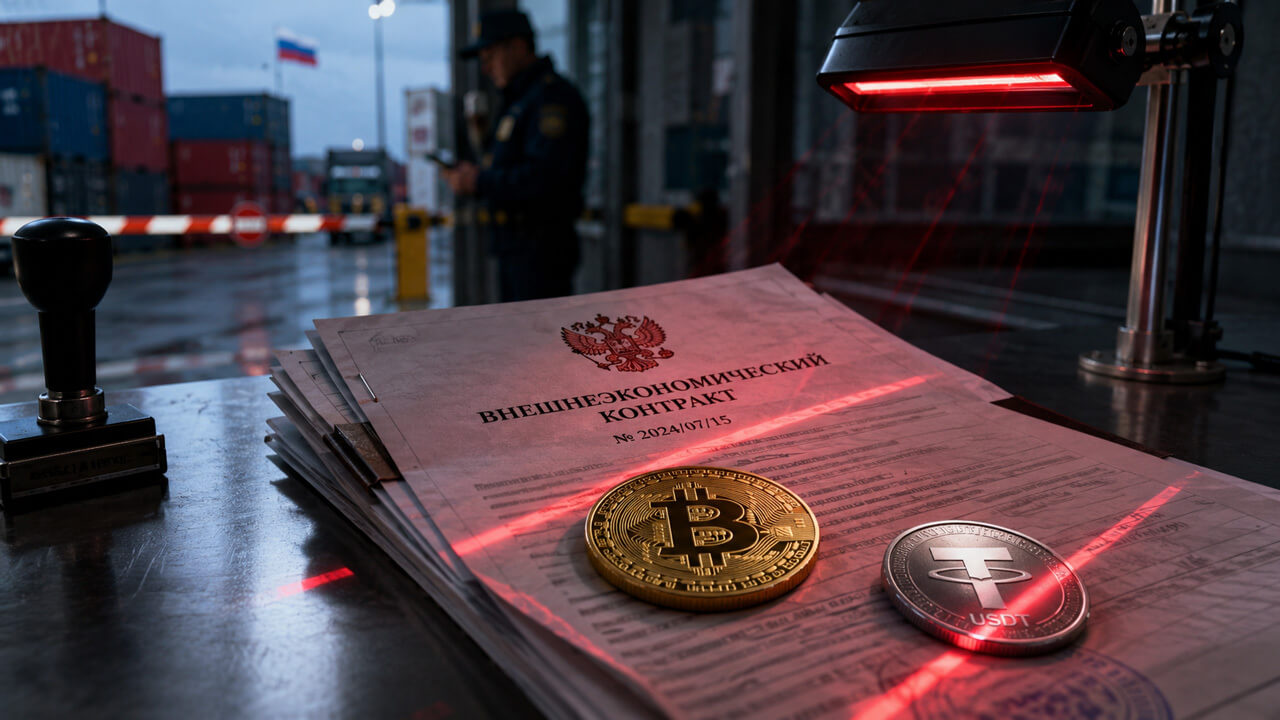

Russia has turned crypto foreign-trade settlement into a live test of how far sanctions pressure can reach beyond banks.
The Bank of Russia says selected exporters and importers may use cryptocurrencies for cross-border settlements under foreign-trade agreements, but only within an experimental legal regime.
Moscow has created a state-backed corridor for selected trade payments while the infrastructure around digital-asset flows remains exposed to sanctions pressure. The Federal Law No. 223-FZ profile records the same boundary: selected digital-currency payments under foreign-trade contracts, with participants and limits set by the ELR.
Russia can make certain crypto settlements lawful under its own framework. The corridor’s usefulness still depends on counterparties, wallets, exchanges, issuers, custodians, liquidity providers, and compliance checks that may sit outside Russia’s control.

A legal corridor with external chokepoints
The corridor gives a Russian exporter or importer a formal route to test digital assets in cross-border commerce, especially where conventional banking has become slower, costlier, or unavailable.
The legal change shifts crypto settlement from an unofficial workaround into a supervised experiment for selected foreign-trade payments.
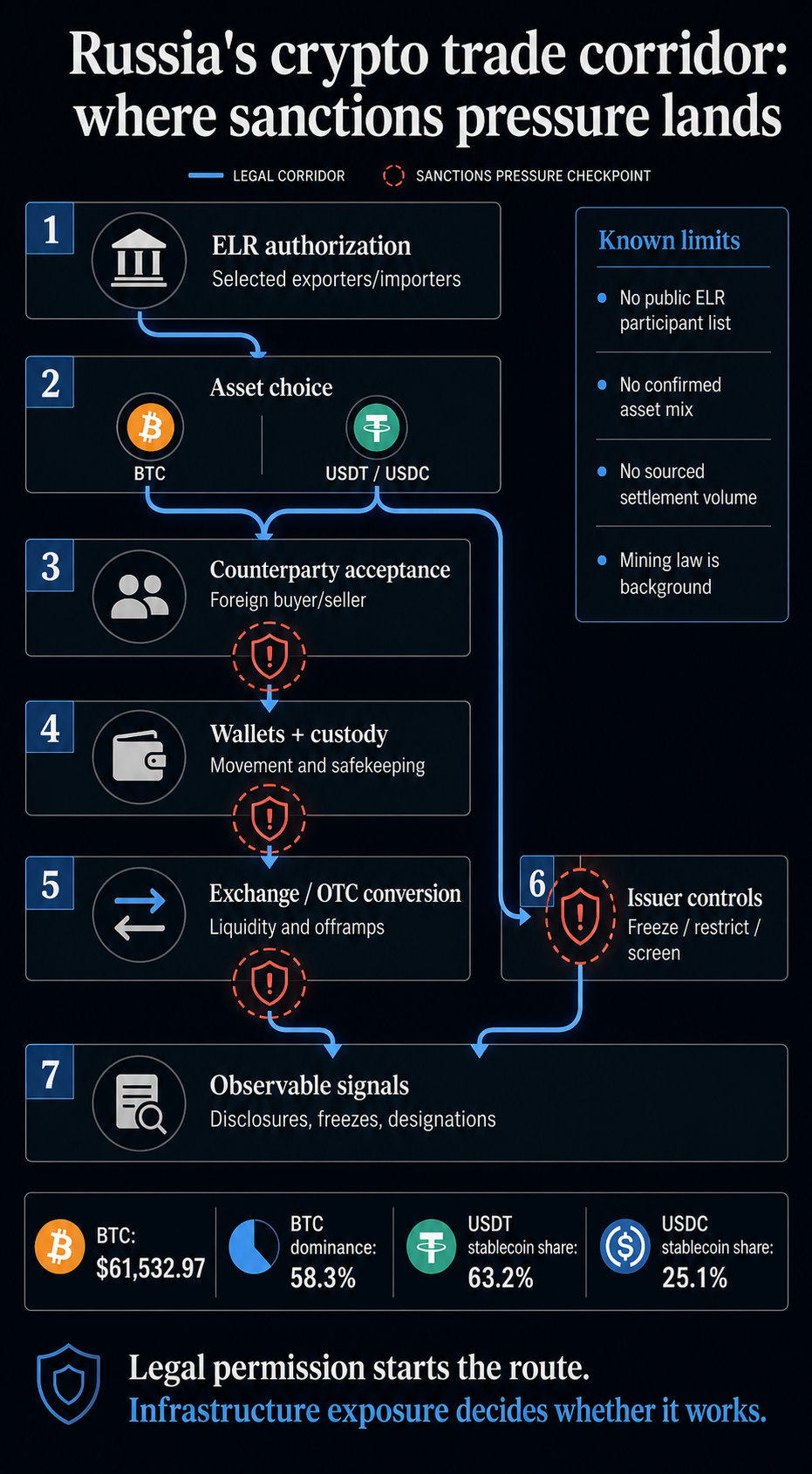
A trade payment still needs more than domestic permission. A buyer and seller have to agree on the settlement asset. Someone has to source liquidity, move the asset, custody it, and convert it into usable value.
If the asset is a dollar-backed stablecoin, the route may touch issuer controls or issuer-linked restrictions. If it is Bitcoin, the route avoids an issuer but still relies on counterparties, analytics, exchanges, custodians, brokers, and offramps before or after the blockchain transfer.
That makes the ELR a market-structure question as much as a legal one. A sanctioned economy can create domestic legal room for crypto trade settlement, while every service provider around that payment path has to evaluate sanctions exposure.
The operational question is whether firms outside the Russian legal perimeter treat the corridor as an acceptable settlement route, a compliance risk, or a path to avoid.
Settlement stepWhat the corridor changesWhere sanctions pressure can landRussian legal authorizationSelected firms can use crypto under foreign-trade agreements inside the ELR.Participant limits, allowed transaction types, and regulatory supervision.Asset selectionBitcoin may offer issuer-free settlement; stablecoins may offer easier dollar accounting.Exchange access, liquidity pools, stablecoin issuer controls, and wallet tracing.Counterparty acceptanceForeign sellers or buyers must be willing to receive or route the asset.Secondary sanctions risk, compliance policies, and bank or exchange relationships.Conversion and offrampsCrypto usually has to become usable currency or inventory value somewhere in the chain.OTC desks, exchanges, custodians, payment firms, and compliance screening.
Russia’s mining framework provides background for this legal stack, rather than for the trade-settlement analysis itself. The Federal Law No. 221-FZ profile helps illustrate how Russia has established rules governing digital currency activity.
It shows the wider legal framework while offering no evidence of domestic payment permission at scale or foreign-trade settlement volume under the ELR.
Where sanctions pressure lands
The US Treasury’s virtual-currency sanctions guidance then sets the enforcement backdrop. Digital-asset firms are expected to screen for sanctioned activity, block prohibited transactions, and maintain controls even when the payment method is crypto.
That framework turns Russia’s corridor into a question for every business that might touch a settlement route.
Treasury has already placed Russia-linked crypto infrastructure inside the sanctions perimeter. In 2022, action against Garantex targeted a Russian virtual-currency exchange.
CryptoSlate’s past coverage of Garantex-linked enforcement provides context on the service provider. Recent sanctions coverage around stablecoin routes and Russian crypto services points in the same direction: enforcement follows the route, the venue, and the intermediary as much as the bank account.

The available record gives no public list of approved ELR participants, asset mix, counterparties, or settlement scale. That absence supports a cautious conclusion.
The corridor is legally real, but current sources support a compliance contest rather than a claim of visible large-scale adoption. If counterparties and service providers decide the sanctions exposure is too high, the route may remain limited or symbolic.
If willing counterparties and offshore liquidity persist, the corridor becomes a practical test of how far sanctions controls can reach into crypto infrastructure.
Bitcoin and stablecoins stress that system in different ways. Bitcoin has no issuer that can freeze a token at the contract or account layer.
The Bitcoin market has the price trading around $59,300 as of press time, with about 58.3% market dominance, making it the obvious reference asset for a state studying nonbank settlement.
Its design also means there is no company standing between the sender and the recipient, unlike with a stablecoin issuer. That issuer-free design still leaves practical chokepoints. Commercial settlement needs liquidity, counterparties, custody choices, and eventual conversion.
A BTC transfer can move peer-to-peer, while a trade route often touches exchanges, brokers, analytics tools, wallets, custodians, or banks at some point in the transaction. Those interfaces are where sanctions compliance can reappear.
Stablecoins solve a different trade problem. A dollar-referenced token can be easier to price than volatile BTC, which is why settlement discussions quickly turn to USDT and USDC, which own 63.2% and 25.1% in stablecoin dominance, respectively.
Circle’s USDC terms reinforce the issuer-control point: stablecoin access sits inside contractual and sanctions-compliance frameworks.

The trade-off is clear. Bitcoin may be harder to stop at the asset layer, but it can be less convenient for invoices and conversions. Stablecoins may be easier for dollar accounting, but issuer controls such as freezing, exchange restrictions, and screening obligations can make them more exposed to direct compliance action.
Russia’s corridor will be shaped by which of those constraints approved participants and counterparties can absorb.
Signals that decide the corridor’s value
The next useful evidence will be operational, not just legal. Bank of Russia disclosures on participants or transaction types would indicate whether the ELR is expanding beyond its policy framework.
Named counterparties, repeated settlement routes, exchange or OTC restrictions, wallet freezes, stablecoin issuer actions, new sanctions designations, and changes in how non-Russian firms handle ELR exposure would all carry more weight than generic crypto market moves.
We now look to whether the corridor produces observable behavior from counterparties and infrastructure providers.
Russia’s trade corridor is now as much a market-structure test as a sanctions story. Moscow can create legal room for selected firms to settle foreign trade in crypto, while Western enforcement can try to make the surrounding infrastructure unusable, risky, or costly.
The outcome will depend less on the existence of the ELR and more on whether the payment path survives contact with the networks that make crypto commercially useful.