
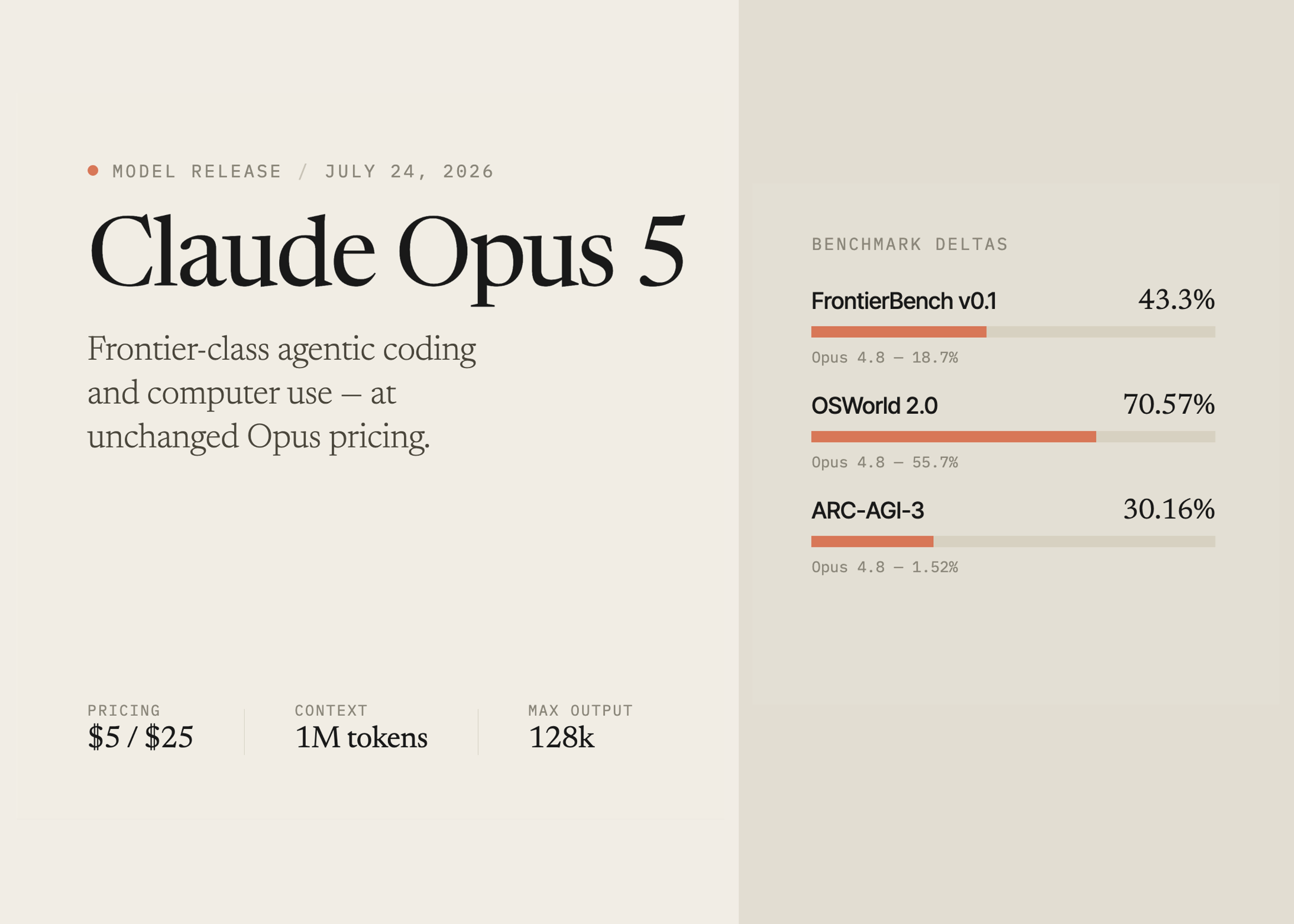

Today, Anthropic released Claude Opus 5. It replaces Claude Opus 4.8 as the Opus-tier flagship. Pricing is unchanged at $5 per million input tokens and $25 per million output tokens.
The Anthropic team positions Opus 5 as approaching the intelligence of Claude Fable 5 at half the price. It is now the default model on Claude Max and the strongest model on Claude Pro.
What actually changed at the API level
Three changes are quite important before any benchmark does:
The model ID is claude-opus-5. Context is 1M tokens as both default and maximum, with no smaller variant. Maximum output is 128k tokens on the synchronous Messages API. The Message Batches API reaches 300k with the output-300k-2026-03-24 beta header. The minimum cacheable prompt drops to 512 tokens, down from 1,024.

Coding and agentic results
On FrontierBench v0.1, a 74-task successor to Terminal-Bench 2.1, Opus 5 scored 43.3% at max effort. Opus 4.8 scored 18.7%. Fable 5 reached 33.7% and GPT-5.6 Sol reached 37.5%. At xhigh effort Opus 5 reaches 44.4% mean reward, its best result.
One detail from that run is worth noting. Opus 5 safety classifiers flagged and refused 5% of API calls, across 4% of trials. Fable 5 classifiers flagged 42% of calls across 26% of trials.
Opus 5 scored 96.0% on SWE-bench Verified and 79.2% on SWE-bench Pro. Fable 5 still edges it on Pro at 80.0%. On SWE-bench Multimodal the jump is larger, from 38.4% to 59.4%.
The agentic numbers are the clearest wins. Opus 5 reached 70.57% on OSWorld 2.0 against 55.7% for Opus 4.8. On Zapier AutomationBench it scored 26.0%, against 17.0% for Opus 4.8 and 17.4% for Fable 5. At medium effort it still scores 24% at $0.89 per task.
On Artificial Analysis GDPval-AA v2, Opus 5 takes the top two leaderboard spots at ELO 1861 and 1827. The xhigh setting beats every other model while using 25% fewer output tokens than max.
Reasoning, and the ARC-AGI-3 result
Anthropic prompted Opus 5 on all six IMO 2026 problems without tools or an agent harness. A three-model judge panel scored all 24 generated solutions correct. Human experts independently graded one pre-specified solution per problem at 7/7. The final 42/42 is gold-medal level, above the 29/42 cutoff.
The ARC Prize Foundation reports a verified 30.16% on ARC-AGI-3 at high effort. That is roughly four times the best previously reported leaderboard score. GPT-5.6 Sol reached 7.78% and Opus 4.8 reached 1.52%. Opus 5 results at max effort were unavailable at release.
On Humanity’s Last Exam, Opus 5 scored 56.3% without tools and 64.7% with them.
The multimodal section carries a practical lesson. Agentic tool use scales test-time compute more cost-effectively than adaptive thinking alone.
On Chartography, Opus 5 scored 29.6% without tools and 83.0% with a container and an image-cropping tool. On BenchCAD Vision2Code, voxel IoU moves from 0.366 to 0.821. With tools, that beats Claude Mythos 5 at 0.678 by a wide margin.
Cyber capability rose, and safeguards were relaxed in one place
Anthropic did not train Opus 5 on cybersecurity tasks. Capability rose anyway, as a byproduct of general capability gains.
On ExploitBench, Opus 5 captured 10.14 mean capability flags in the AutoNudge arm. It produced 99 full arbitrary-code-execution exploits. Mythos 5 produced 132. On OSS-Fuzz, Opus 5 scored non-zero on 79.4% of targets. Mythos 5 reached roughly 80%. But Opus 5 completed 4 full exploits to Mythos 5’s 13.
That gap defines the safeguard design. Opus 5 is nearly as strong as Mythos 5 at finding vulnerabilities, and substantially behind at exploiting them. So Anthropic unblocked vulnerability finding in source code. Binary-based scanning, penetration testing and exploit generation stay blocked. Classifiers are expected to intervene around 85% less often than on Fable 5. Defenders can apply to the Cyber Verification Program.
UK AISI tested early checkpoints on three cyber ranges at 100M tokens per attempt. Opus 5 solved ‘The Last Ones’ end-to-end in 8 of 10 attempts. It did not solve the harder ‘Doing Life’ range. It reached step 22 of 23, further than any model tested.
Under the RSP, Anthropic treats Opus 5 as having CB-1 capabilities but not CB-2. It applies the same ASL-3 protections used for Opus 4.8. The AI R&D threshold is not crossed.
Prompt injection is the standout safety number
On the Gray Swan indirect prompt injection benchmark, attacker success within 15 attempts fell from 5.5% on Opus 4.8 to 2.0%. Mythos 5 sits at 2.6% and GPT-5.6 Sol at 20.0%.
In browser environments run through Claude Cowork, attack success dropped from 31.5% on Opus 4.8 to 3.70%. That figure is with no safeguards applied. With auto mode enabled, it reached 0% across all 129 environments.
Key Takeaways
- Opus 5 ships at unchanged $5/$25 pricing with a 1M-token context window as both default and maximum.
- Thinking is now on by default, and disabling it above high effort returns a 400 error.
- Agentic evaluations are the clearest wins: OSWorld 2.0 at 70.57%, AutomationBench at 26.0%, ARC-AGI-3 at 30.16%.
- Cyber safeguards relax only for source-code vulnerability finding; exploitation paths stay blocked.
- Anthropic publishes its own negatives, including slightly higher factual hallucination than Opus 4.8.
Sources: Anthropic launch post, Claude Opus 5 System Card, What’s new in Claude Opus 5, TechCrunch, and CodeRabbit independent review
Asif Razzaq is the CEO of Marktechpost Media Inc.. As a visionary entrepreneur and engineer, Asif is committed to harnessing the potential of Artificial Intelligence for social good. His most recent endeavor is the launch of an Artificial Intelligence Media Platform, Marktechpost, which stands out for its in-depth coverage of machine learning and deep learning news that is both technically sound and easily understandable by a wide audience. The platform boasts of over 2 million monthly views, illustrating its popularity among audiences.