



DeFi has reclaimed $95 billion in total value locked. The number is significant. What it represents is more significant than the number.
A CryptoQuant report drawing on DeFiLlama data has identified a recovery that goes beyond the return of capital. After the post-2021 correction erased the speculative froth from the DeFi market, the $95 billion now locked in on-chain protocols reflects something the 2021 peak did not: sustained inflows driven by real demand rather than yield-chasing momentum. The capital has returned. This time, it appears to be staying.

The structural shift the report identifies beneath the TVL figure is the more consequential development. DeFi is no longer being evaluated primarily as a high-yield speculation venue. It is being re-evaluated as financial infrastructure — a replacement for the intermediary layer that traditional finance places between users and their assets. The distinction is fundamental: in traditional finance, institutions hold assets on behalf of users. In DeFi, users hold their own assets via smart contracts. Trust moves from institutions to code.
At the center of that shift is self-custody — and in Japan, that shift is becoming practical rather than theoretical. Hashport Wallet is lowering the barrier to private key ownership for mainstream users, making the infrastructure of self-custody accessible to a population that has historically kept its financial assets in institutional hands.
The DeFi Infrastructure Is Assembling. Japan Is Watching Closely
The report identifies stablecoins as the connective tissue that makes DeFi functional rather than theoretical. Price-stable assets solve the fundamental friction that prevented cryptocurrency from replacing traditional payment infrastructure: volatility.
When the medium of exchange fluctuates 10% in a session, it cannot serve as a foundation for payments, transfers, or lending. Stablecoins remove that friction. Their expanding global market size is not a crypto trend — it is the growth of a settlement layer that real-world financial activity increasingly depends on.
The Ethereum network data provides the on-chain confirmation. Transaction activity has surged recently — and the report draws the distinction that matters most in interpreting that surge. When network activity increases alongside rising prices, it suggests organic demand rather than speculative positioning. Users are not just betting on Ethereum. They are using it. That combination — activity growth and price growth occurring together — is the signature of a strengthening on-chain economy rather than a reflexive bubble.

Japan is translating these global developments into a domestic financial model with a specific architectural choice. JPYC — a yen-denominated stablecoin — makes the entire DeFi stack practically accessible to Japanese users and institutions in local currency. The friction of currency conversion, the barrier of dollar-denominated protocols, the regulatory complexity of foreign stablecoin exposure — JPYC addresses all three simultaneously.
What JPYC and Hashport are building together is not a crypto product. It is a national financial access layer: self-custody infrastructure paired with a local-currency settlement asset, delivering the full capability of global DeFi to a population that holds some of the world’s largest household savings. That combination — accessibility, sovereignty, and local currency denomination — is what the report identifies as a uniquely viable model for regulated economies entering on-chain finance.
Stablecoin Dominance Stalls After Sharp Expansion
Stablecoin dominance has entered a consolidation phase after a strong upward move that defined late 2025 and early 2026. The chart shows a clear expansion from roughly 7% to above 13%, reflecting a significant shift in capital positioning. That rise typically signals a defensive market environment, where participants rotate out of volatile assets into stablecoins.
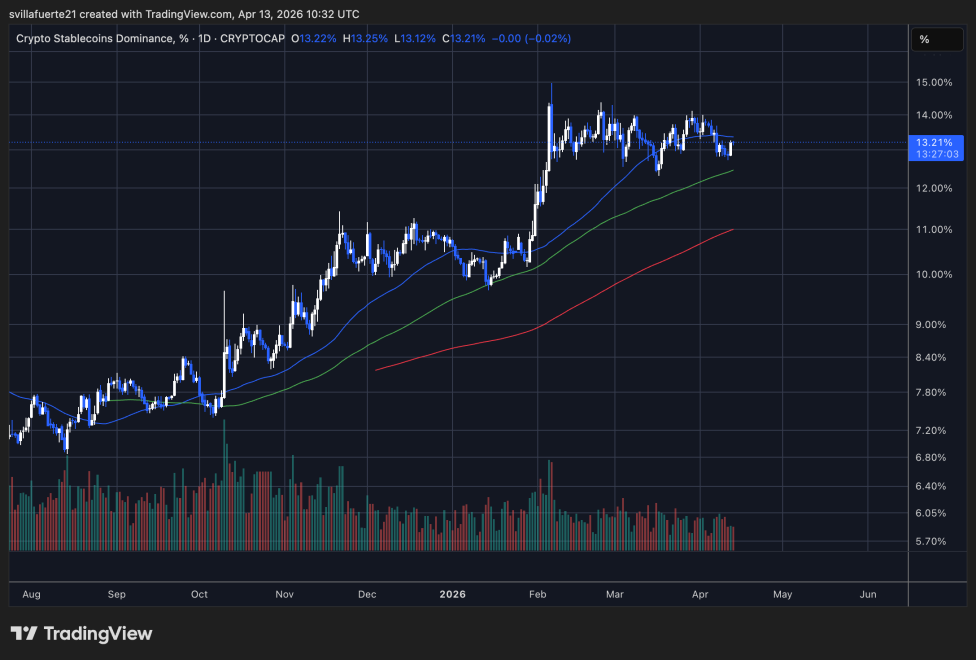
Since peaking near the 14% region in February, dominance has stabilized around 13.2%, forming a horizontal range rather than continuing higher. This shift from expansion to consolidation suggests that the initial risk-off move has already occurred, and the market is now in a holding pattern rather than actively de-risking further.
Technically, the structure remains constructive. Stablecoin dominance is holding above its 50-day (blue) and 100-day (green) moving averages, both trending upward, while the 200-day (red) continues to rise below. This alignment confirms that, despite the pause, the broader trend of capital preservation remains intact.
Structurally, this is a plateau at elevated levels. A break above 14% would signal renewed risk aversion, while a move below 12% would indicate capital rotating back into crypto assets. For now, the market remains cautious, not yet risk-on.
Featured image from ChatGPT, chart from TradingView.com
Editorial Process for bitcoinist is centered on delivering thoroughly researched, accurate, and unbiased content. We uphold strict sourcing standards, and each page undergoes diligent review by our team of top technology experts and seasoned editors. This process ensures the integrity, relevance, and value of our content for our readers.