

Key Takeaways
- Ethereum’s EIP-8222 could hide validator links as roughly 1/3 of ETH remains staked.
- Sygnum says stronger privacy may attract institutions but add delays, costs, and compliance work.
- EIP-8222 has no launch date; Ethereum must balance anonymity with regulated firms’ controls.
Sygnum’s Dubuis Warns Privacy Upgrade Could Raise Institutions’ Execution Costs
Ethereum’s staking market is approaching record levels, with roughly one-third of all ether locked in validators. Institutional participation has also continued despite weaker market conditions. Still, the network exposes information many professional investors would prefer to keep private.
A staker’s deposit address, validator and withdrawal credentials currently create a visible trail. Blockchain analytics firms can use those links to estimate an institution’s position size, entry timing and staking strategy.
“For an institutional allocator, that means position size, timing and strategy are effectively public,” said Thibault Dubuis, product lead for staking and decentralized finance at Sygnum Bank.
EIP-8222 Targets Validator Traceability
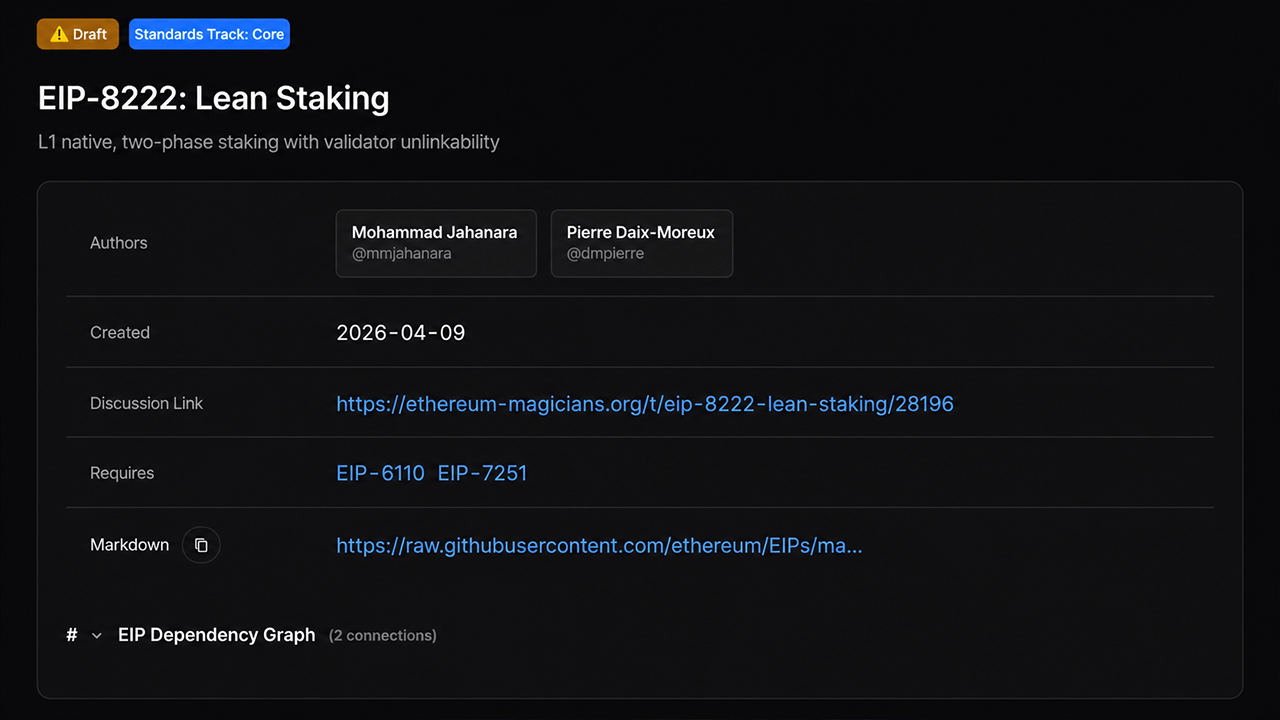
Ethereum Improvement Proposal (EIP) 8222, known as “Lean Staking,” seeks to address that problem at the protocol level. The proposal would use STARK-based cryptography to separate deposits from withdrawals and re-anonymize validators.

It forms part of the broader Lean Ethereum redesign. If adopted, the system could allow institutions to stake without revealing their full activity to the market.
Banks and regulated custodians can already provide limited privacy by pooling client assets in omnibus wallets. However, the wallet used for staking typically remains publicly connected to the validator and its withdrawal credentials.
“This is what makes EIP-8222 significant,” Dubuis said. “In practice, it would let an institution stake without broadcasting its book to the rest of the market.”
The proposal remains under discussion and has not been scheduled for deployment. Changes of this scale would require broad agreement from Ethereum developers and stakeholders.
Privacy Brings Operational Trade-Offs
The design could also create friction for institutional users.
Fixed deposit denominations may improve anonymity by placing transactions within a larger pool of similar amounts. Yet they could make it harder for institutions to stake or withdraw precise sums, reducing the capital efficiency gained from Ethereum’s Pectra upgrade.
Users may also need to wait before claiming assets to prevent transactions from being linked. That could introduce delays and complexity into business-to-business workflows.
Privacy would not eliminate the other risks associated with institutional staking. Firms would still need to manage validator keys, custody arrangements, slashing exposure, regulatory reporting and internal controls.
Auditors may also require proof that assets can only be withdrawn to wallets controlled by the institution or its clients. Protocol anonymity must therefore coexist with off-chain accountability.
“Privacy lowers the barrier to entry but raises the execution barrier,” Dubuis added.
For institutional investors, Lean Staking could remove an important obstacle. However, its success will depend on whether Ethereum can protect trading strategies without weakening the controls regulated firms need to operate.