


Bitcoin could be approaching a supply shock phase as retail investors sell under pressure while long-term holders keep their coins dormant, according to a new market analysis by CryptoQuant.
Summary
- CryptoQuant says Bitcoin may be entering a supply shock phase as whales remain inactive and retail investors sell at a loss.
- Around 71% of Bitcoin UTXOs remain profitable, while roughly 28% are currently underwater, reflecting stress among short-term holders.
- Bitcoin exchange reserves have fallen by about 204,000 BTC in 2026, potentially tightening supply and setting the stage for a price surge.
At the time of the report, Bitcoin (BTC) was trading around $69,446, with blockchain data showing that 71.41% of all unspent transaction outputs (UTXOs) remain in profit.

UTXOs represent Bitcoin that has not been spent since its last transaction and are often used to gauge investor profitability across the network.
Despite the majority of holders sitting on gains, roughly 28.58% of UTXOs are currently at a loss, signaling that some market participants, primarily short-term traders, are experiencing financial stress.
CryptoQuant analysts say this pressure is largely concentrated among short-term holders rather than large investors.
Retail selling contrasts with whale dormancy
Data from the Spent Output Profit Ratio for short-term holders (SOPR-STH) shows a reading near 0.97, indicating that this group is selling coins at a loss.

This dynamic suggests that the current selling pressure is driven primarily by retail investors exiting positions during periods of market volatility.
Meanwhile, large holders—often referred to as whales—have remained largely inactive, with older bitcoin holdings showing little movement on-chain.
Analysts interpret this dormancy as a sign that institutional or long-term investors remain confident in Bitcoin’s broader market outlook.
Exchange reserves decline as coins move off trading platforms
Another key signal highlighted in the analysis is the continued decline in Bitcoin exchange reserves.
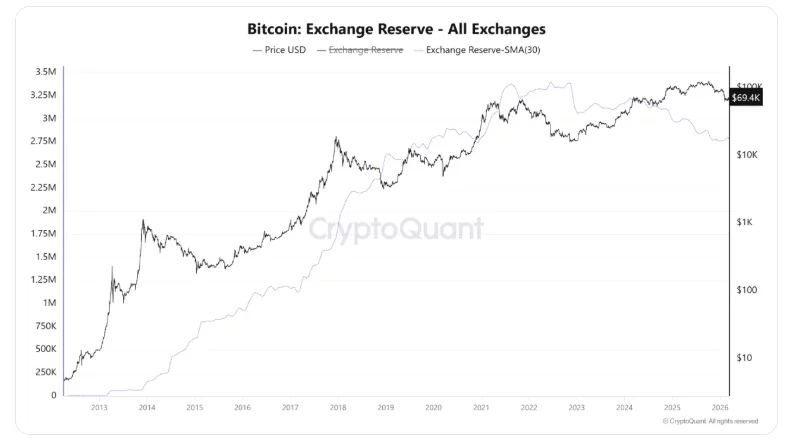
Year-to-date, reserves have dropped from 2.990 million BTC to 2.786 million BTC, representing a reduction of roughly 204,000 BTC across trading platforms.
Such outflows often indicate that investors are transferring coins to cold storage or long-term custody wallets rather than preparing them for immediate sale.
According to CryptoQuant, this trend suggests coins are gradually moving from “nervous hands” to longer-term holders.
The combination of falling exchange reserves and inactive whale wallets could set the stage for a potential supply shock.
A supply shock occurs when sell-side liquidity becomes scarce, meaning fewer coins are available for sale on exchanges. If demand rises during such conditions, prices can move sharply higher.
CryptoQuant analysts argue that the current market environment reflects “fear exhaustion,” where retail capitulation gradually clears excess selling pressure.
If that forced selling cycle ends while long-term holders continue to hold their positions, the market could enter a phase where reduced supply amplifies the impact of new demand on Bitcoin’s price.