


According to data from Glassnode, US spot Bitcoin exchange-traded funds (ETFs) have recorded their largest balance drawdown of the current market cycle following the early October all-time high.
Nonetheless, despite the recent outflows, the broader ETF picture still remains constructive.
Bitcoin ETFs See Deepest Cycle Pullback as Balances Fall to 1.26 Million BTC
Glassnode data shows that since October, US spot Bitcoin ETF balances have declined by roughly 100,300 BTC. At press time, total holdings stood at approximately 1.26 million BTC.
The contraction reflects sustained net outflows, as investors have withdrawn capital from spot ETFs, leading funds to reduce holdings. According to SoSoValue, $1.6 billion was pulled from these products in January alone, extending a streak of monthly outflows that began in November 2025.

The decline in ETF balances has unfolded alongside a broader market downturn. Bitcoin has trended lower since reaching its record high of $126,000 in October. The weakness has spilled into 2026, fueling elevated fear and uncertainty across the market.
Although spot ETFs were widely seen as a structural catalyst during Bitcoin’s rally, experts suggest the same mechanism may have intensified downside pressure during periods of redemptions. In early February, Arthur Hayes argued that institutional dealer hedging activity is amplifying downward pressure on BTC prices.
“Institutional de-risking has added structural weight to the ongoing weakness, reinforcing the broader risk-off environment,” Glassnode added.
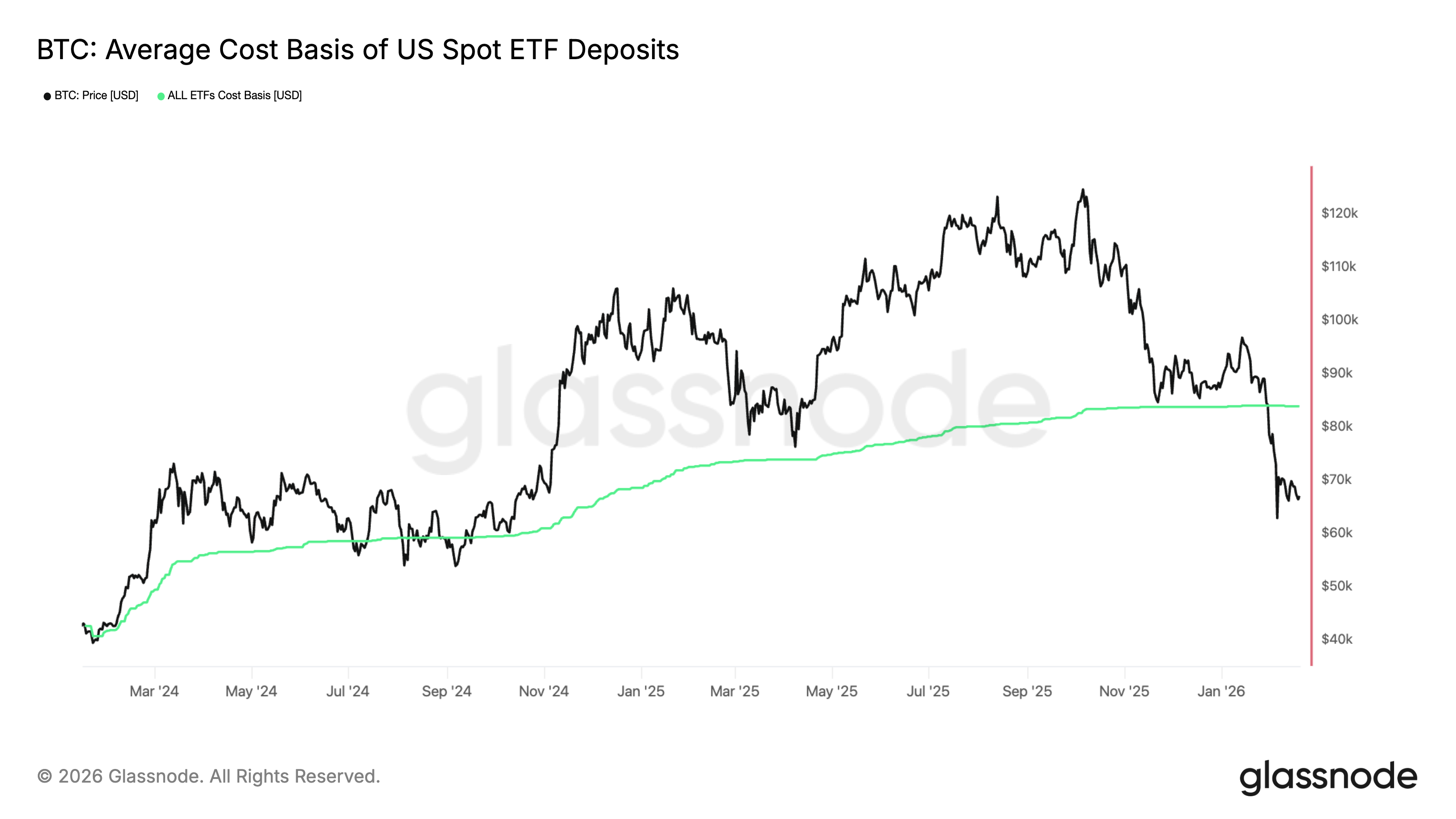
The strain extends beyond ETF outflows and into mounting unrealized losses. According to Glassnode, the average entry price for US spot Bitcoin ETF investors stands at approximately $83,980 per BTC.
With Bitcoin trading at $67,349 at the time of writing, this cohort is currently sitting on paper losses of roughly 20%.
Meanwhile, the outflows are not isolated to Bitcoin. BeInCrypto reported $173 million exited digital asset funds last week. This marked the fourth consecutive week of redemptions, totaling $3.7 billion for the period.
Bitcoin ETF Net Inflows Still at $53 Billion Despite Recent Outflows
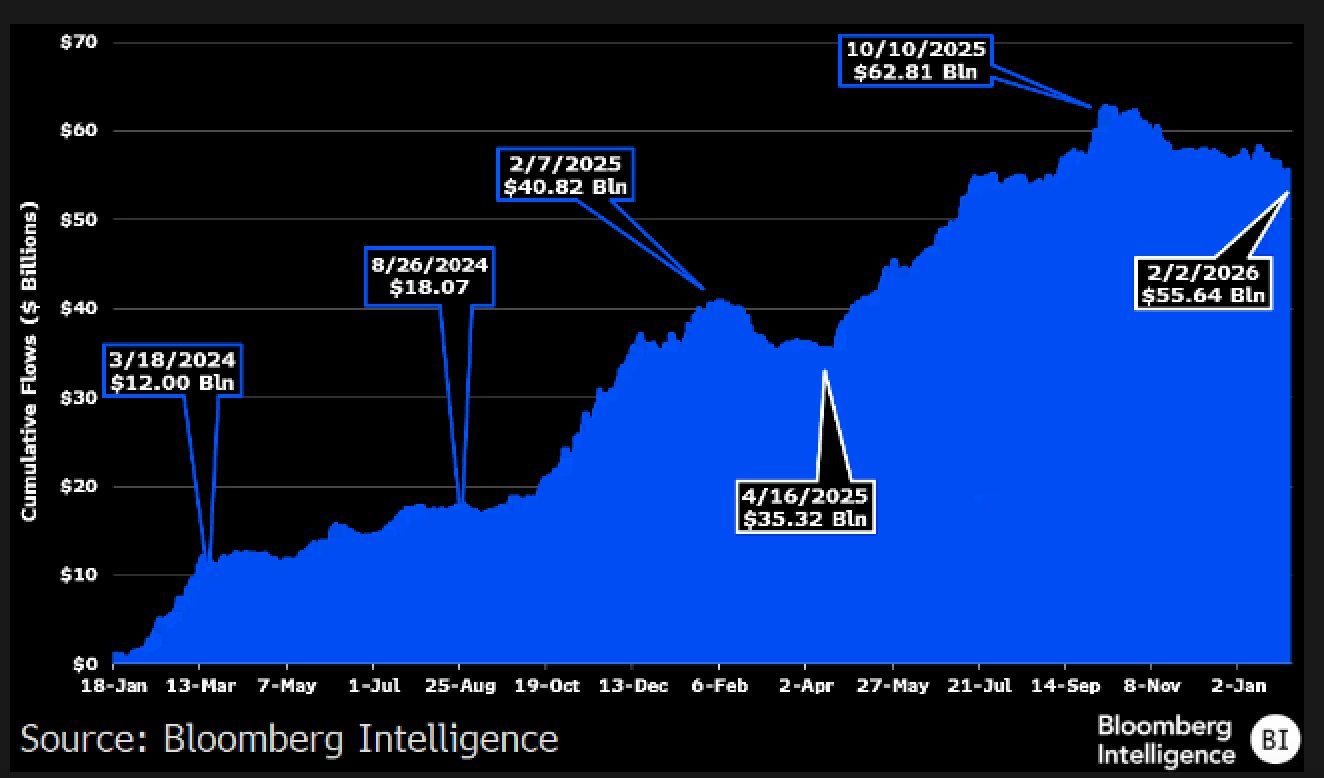
Despite the pessimism, some analysts continue to emphasize the longer-term picture. Bloomberg senior ETF analyst Eric Balchunas noted that cumulative net inflows into Bitcoin ETFs still stand at roughly $53 billion, down from a peak of over $63 billion in October 2025, even after recent outflows.
“Our (more bullish than most of our peers) prediction was $5-15b in first year. This is imp context to consider when looking/writing about the $8b in outflows since 45% decline and/or the relationship bt btc and Wall street, which has been overwhelmingly positive,” he added.
Taken together, the data suggest the current retracement reflects cyclical risk reduction rather than a structural reversal. ETF flows have amplified both upside and downside moves, embedding Bitcoin more deeply into traditional capital markets dynamics.
While short-term pressure may persist amid broader macro uncertainty, the scale and speed of institutional adoption since launch indicate that Bitcoin’s integration into Wall Street portfolios remains intact.