
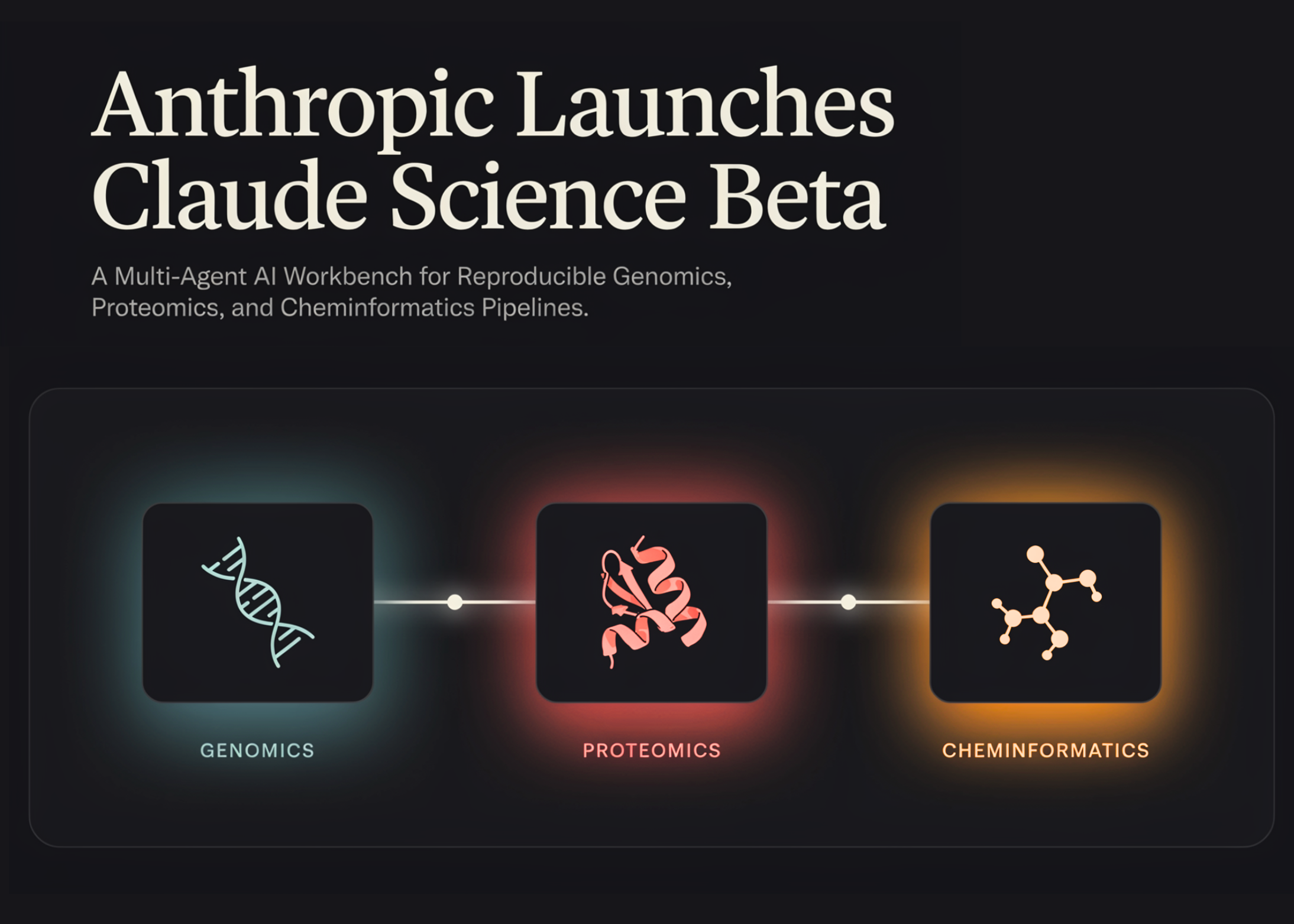

This week, Anthropic released Claude Science. It is an app for scientists, available in beta. It runs on Anthropic’s existing Claude models, not a new model. The app targets researchers who juggle databases, notebooks, and cluster terminals. It runs multi-step research and records how each result was made. The beta is available for Pro, Max, Team, and Enterprise plans.
Claude Science builds on Anthropic’s life sciences work from last fall. That earlier work connected Claude to the scientific ecosystem through MCPs and skills.
What is Claude Science?
Claude Science is an AI workbench for research. It integrates the tools and packages researchers use most. It analyzes literature, executes multi-step research, and produces detailed artifacts. You can refine figures and manuscripts until they are publication-ready.
You talk to one generalist coordinating agent in plain language. That agent has access to over 60 curated skills and connectors. These come pre-configured for genomics, single-cell, proteomics, structural biology, and cheminformatics.

You can run it locally on macOS or Linux. You can also work on a remote machine over SSH or an HPC login node. Every output carries an auditable history of how it was made.
How The Multi-Agent Architecture Works
A generalist coordinating agent receives your plain-language request. It can spin up other agents to handle the work. It can also engage specialist agents that users create themselves. NVIDIA describes these as preconfigured, domain-specialized agents. Each knows the established workflows for its field.
A separate reviewer agent runs as the pipeline executes. It inspects the outputs step by step. It flags incorrect citations and numbers it cannot trace. It also flags figures that do not match their underlying code. Then it self-corrects as it goes.
Reproducibility And Provenance
Scientific research is inherently visual. So Claude Science generates figures and manuscripts alongside the code that created them. It natively renders 3D protein structures, genome browser tracks, chemical structures, and more.
When it generates a figure, it records the exact code and environment. It also records a plain-language description and the full message history. This makes the work easier to validate and reproduce months later.
You can edit figures in plain language. For example, you can ask it to change an axis to log scale. The agent then edits its own code. You can also fork a session to compare two approaches without losing the original.
Compute that Scales on Demand
Large analyses often need more than a laptop. Folding a protein is one example. Claude Science drafts a plan before reaching new resources. It asks for approval and lets you review or revoke any decision. It then writes and submits the job to your own infrastructure.
That means your HPC cluster over SSH or your Modal account. The analysis scales from a single GPU to hundreds as needed. Because agents hold context in memory, a large dataset loads only once.
The app runs on your lab’s own infrastructure. So large or sensitive datasets never have to leave their current systems. Only the context needed for each step is sent to Claude.
Domain Coverage and NVIDIA BioNeMo
Scientific knowledge is scattered across hundreds of specialized sources. In biology, this includes UniProt, PDB, Ensembl, and Reactome. It also includes ClinVar, ChEMBL, GEO, journals, and preprint servers. Specialist agents query and synthesize across these sources for you.
Claude Science also uses skills from NVIDIA’s BioNeMo Agent Toolkit. The toolkit packages GPU-accelerated capabilities as callable skills. This connects natively to Evo 2, Boltz-2, and OpenFold3. Evo 2 is a genomics foundation model. Boltz-2 handles biomolecular interaction prediction. OpenFold3 handles protein structure prediction.
Use Cases With Examples
Beta users have run single-cell RNA sequencing analysis and CRISPR screen design. They have also run protein structure prediction and cheminformatics.
- Target nomination: Manifold Bio designs tissue-targeting medicines. It used Claude Science to nominate targets for its latest experiments. For each tissue and target, the app assessed surface expression, trafficking, and safety. It then ranked candidates against Manifold’s own proprietary criteria. Manifold said the app did this end to end, unlike a general coding assistant.
- Long-form literature review: Jérôme Lecoq at the Allen Institute built a computational review template. It comprised about 20 custom skills for long-form reviews. Sub-agents read thousands of papers into an evidence state database. The pipeline then wrote each section using actor-critic agent pairs. Such reviews once took his team as long as two years. He now has about 10 reviews, many over 100 pages.
- Genomic epidemiology: Stephen Francis at UCSF studies the molecular epidemiology of glioma. Claude Science ran germline workups in roughly one-tenth the prior time. His group independently validated the results.
Comparison Table
Extending Claude Science
Claude Science is an app, so it has no separate inference API. You extend it through connectors and skills, which persist across sessions.
You connect a lab tool through a Model Context Protocol (MCP) connector. This is the standard MCP client config format:
“mcpServers”: {
“lab-eln”: {
“command”: “npx”,
“args”: [“-y”, “@lab/eln-mcp-server”],
“env”: { “ELN_API_KEY”: “REPLACE_ME” }
}
}
}
You save an existing pipeline as a reusable skill. A skill is a folder containing a SKILL.md file:
name: rnaseq-qc
description: Run the lab’s standard RNA-seq quality-control pipeline on a FASTQ directory.
—
# RNA-seq QC
1. Run `pipelines/qc.sh <fastq_dir>`.
2. Summarize the per-sample metrics.
3. Flag any sample below the QC threshold.
Future sessions inherit these connectors and skills automatically. So you keep your validated tools and data, while Claude orchestrates them.
Key Takeaways
- Claude Science is a beta app for macOS and Linux; it runs on Anthropic’s existing Claude models.
- A coordinating agent delegates work, while a separate reviewer agent checks citations, numbers, and figures.
- Every figure ships with its exact code, environment, description, and full message history.
- Compute runs locally, on HPC over SSH, or on Modal, scaling from one GPU to hundreds.
- It ships with 60+ databases and NVIDIA BioNeMo skills (Evo 2, Boltz-2, OpenFold3) for life sciences.
Check out the Technical details here. Also, feel free to follow us on Twitter and don’t forget to join our 150k+ML SubReddit and Subscribe to our Newsletter. Wait! are you on telegram? now you can join us on telegram as well.
Need to partner with us for promoting your GitHub Repo OR Hugging Face Page OR Product Release OR Webinar etc.? Connect with us
Michal Sutter is a data science professional with a Master of Science in Data Science from the University of Padova. With a solid foundation in statistical analysis, machine learning, and data engineering, Michal excels at transforming complex datasets into actionable insights.