

Just when you thought crypto was getting boring, a new phenomenon is lighting up Crypto Twitter — Fake World Assets (FWAs). Yes, really.
It’s the latest iteration of the onchain gacha craze, where users receive a random collectible, or collectibles, that are usually worth very little, but are sometimes worth quite a lot.
Within four days of launch, FWAs guzzled so much Ethereum gas that they briefly became the chain’s largest gas consumer by fees over a 24-hour period.
At its peak on July 25, FWAs generated approximately $1.53 million in daily fees, and even leapfrogged Tether and Circle to briefly rank among Ethereum’s biggest consumers of blockspace. Its creators, TokenWorks, proclaimed:
“4 days since launch. Fake World Assets are the next big thing.”
TokenWorks is far from an impartial observer, but TVL continues to climb, reaching over $6.15 million on July 31. Fee revenue has now eased to around $350,000 per day, which equates to an annualized run rate of roughly $268 million. By August 1, FWA had seen 10,000 ETH in volume, and 100,000 purchases. Some of the activity is driven by users trying to access early FWA token incentives, but there also appears to be genuine interest in the gamified mechanic.
Fake World Assets TVL and fees. Source: DeFiLlama
Not everyone is convinced the excitement around FWA will last. Simon Dedic, founder of venture capital firm Moonrock Capital, and an early backer of onchain collectible platforms, tells Magazine:
“I’m very bullish on gamified commerce… my skepticism on FWA is specific.”
Dedic argues that much of the current activity is driven by generous token incentives rather than genuine demand.
“The whole thing is purely aimed at crypto degens so they can gamble and speculate,” he says.
So, is this just another short-lived obsession, or has the industry finally stumbled upon something built to last?
All very interesting, but what the heck are FWAs?
Crypto has spent years trying to put the real world onchain, from stocks and bonds to collectible cards and Brazilian cows.
Related: Gambling on random Pokémon cards: Onchain gagcha hits record high as crypto sinks
TokenWorks decided to flip the idea on its head by creating Fake World Assets, which are just NFTs. Rather than buying a specific collectible like a Bored Ape, users pay to spin an onchain “gacha” machine for the chance to win a randomly selected NFT backed by Ether.
The prizes on offer come from dozens of well-known collections, like CryptoPunks and Azuki to Lil Pudgys and Art Blocks.
Fake World Assets is just the latest Ethereum-based protocol to put a new spin on the craze.
Gacha is short for gachapon/gashapon, which are vending machines invented in Japan in the 1960s that spit out a random toy in a capsule. This mechanic migrated to mobile and browser games, with the loot boxes in Dragon Collection in 2010 often cited as the first major gacha game. Meanwhile a similar mechanic was at work with real world Pokemon trading card “booster packs” that offered a random assortment of collectible cards, of various rarity levels and values.
These cards were subsequently tokenzied onchain by projects such as Collector Crypt, Beezie and Courtyard. As Magazine reported previously, onchain gacha saw a record $324 million in volume in June. (Hundreds of these tokenized cards have now been wrapped for use on FWA.)
The concept is expanding every week, with developers experimenting with randomized “token packs” containing ERC-20 tokens, while StockRip on Robinhood chain, shows how tokenized stocks can be wrapped into NFT-based gacha packs.
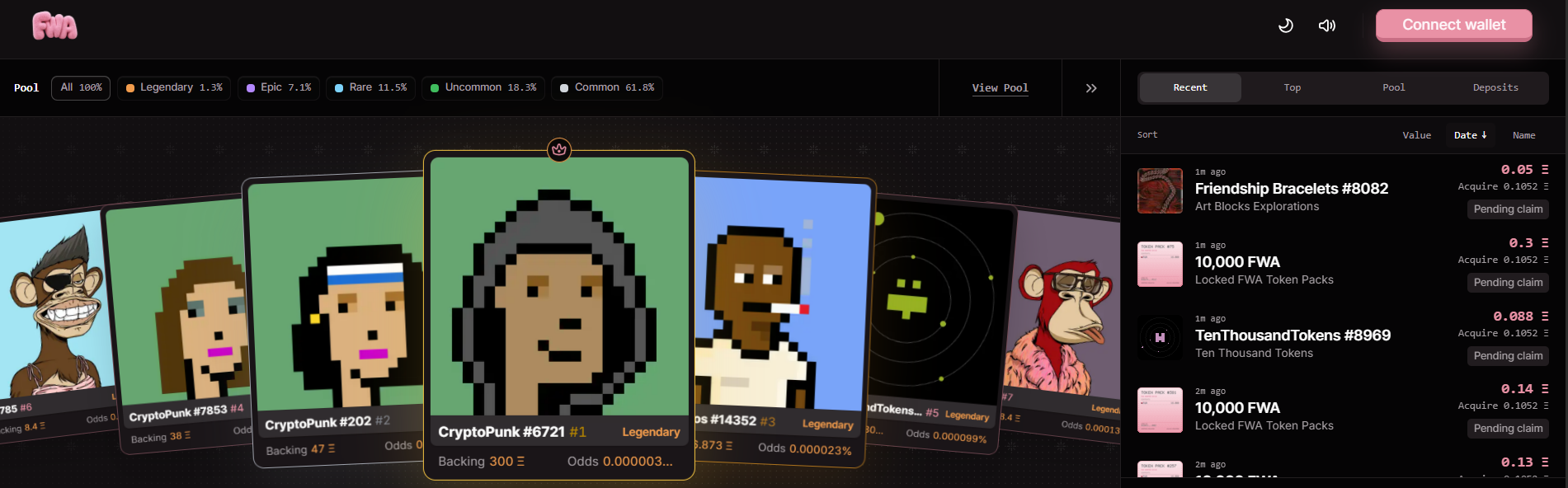
Fake World Assets. Source: fwa.fun
As AzFlin, founder of DAO launchpad daos.world and a former Uniswap engineer, says:
“Just when you think everything in crypto has been invented, something new springs up.”
What is the appeal of onchain gacha?
The gacha mechanic combines crypto, collectibles and gambling . As pseudonymous crypto commentator 2Lambroz puts it, from the player’s perspective, “you’re buying a lottery ticket on the pool.”
“People enjoy playing the lottery, and it’s important to take that seriously,” says Benjamin Lockwood, a Wharton economist whose research into state-run lotteries found that people value the experience itself, not just the chance of winning.
Related: Pudgy Penguins expands retail footprint with Target trading card rollout
Meir Statman, the behavioral finance pioneer and professor at Santa Clara University and author of A Wealth of Well-Being, tells Magazine:
“There is a parallel to ‘onchain gacha’ in people bidding on the contents of abandoned storage units. Most find items worth placing in the trash, but some find items they can sell on eBay. One found a painting worth hundreds of thousands of dollars. These combine hope for riches with playfulness. This is what lotteries offer.”
Two sides to every story
Why do people play the lottery? Source: Knowledge at Wharton
There are two sides to the FWA protocol.
NFT holders become liquidity providers (LPs), depositing collectibles alongside ETH and earning a share of the fees while their position remains in the pool.
Players, meanwhile, pay for the chance to pull a randomly selected NFT, deciding afterwards whether to keep it or redeem most of its attached ETH value instead. (Blockworks Research notes that at present, around 70% of purchasers choose to convert their winnings to FWA.)
As 2Lambroz explains, LPs are effectively hoping their NFT stays in the pool long enough to earn fees before it’s selected, while players are chasing the chance of landing a prize worth far more than the cost of a spin.
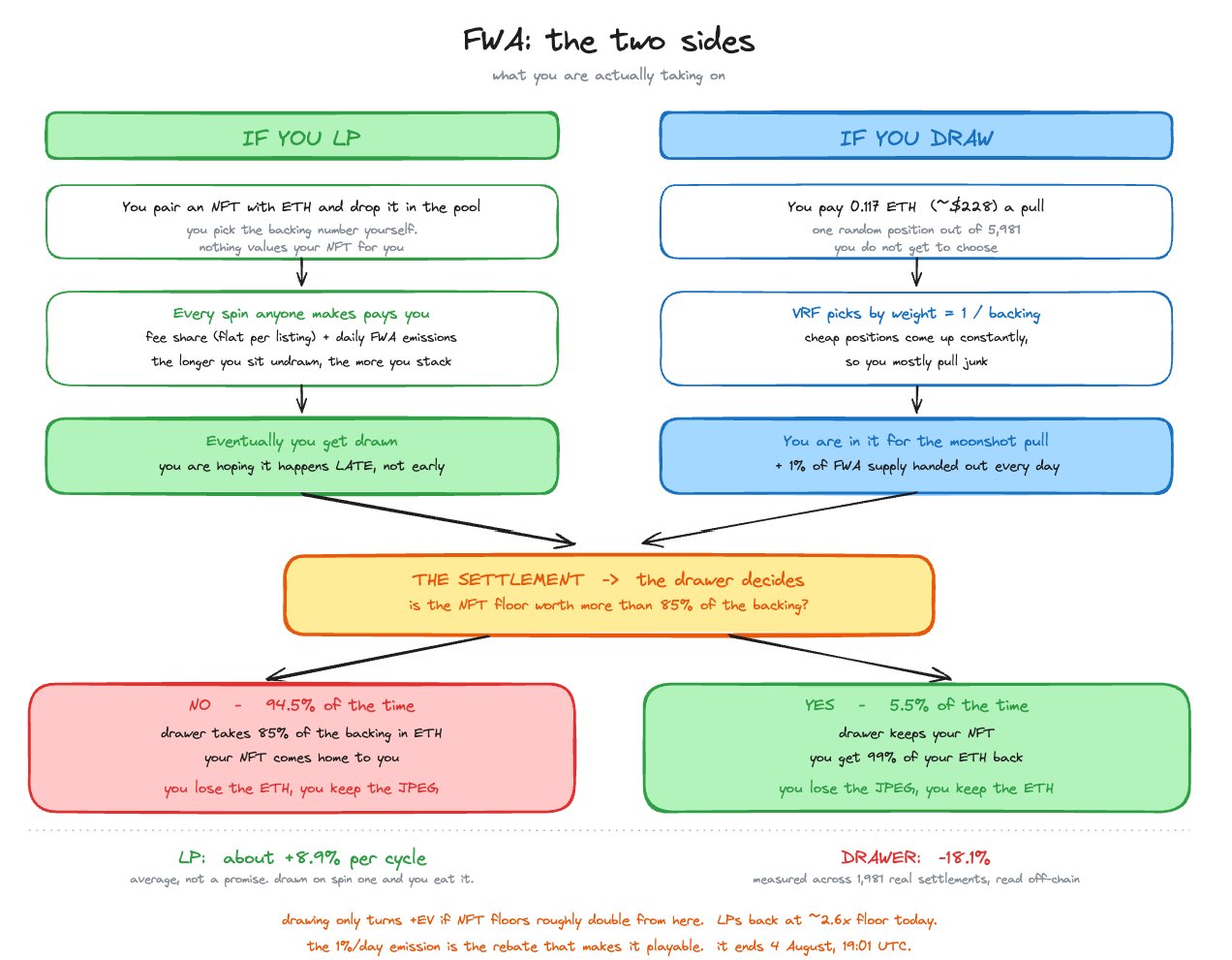
FWA: The two sides. Source: 2Lambroz
Self-proclaimed Ethereum maxi, Materkel says:
“The most fun NFT/casino primitive in over a decade of crypto, where users actually get to be both players and the house at the same time […] Money legos on Ethereum are back!”
Can the hype last?
While Dedic believes much of the activity relates to token incentives, he says he’s “very bullish on gamified commerce for a generational reason.”
“The further Gen Z moves into being the generation with the strongest buying power, the more shopping is going to be gamified and come with a dopamine kick attached.”
And rather than offering random NFTs from last cycle, Dedic believes the mechanism is better suited to assets people already want to own, such as collectibles like Pokémon cards, watches and even whiskey.
“I see enormous potential in selling much-demanded assets in a gamified way,” he says. “I see very little in building Ponzi schemes to create demand for assets nobody wanted in the first place.”
The real test will come when the novelty wears off and the incentives fade. If users keep spinning anyway, onchain gacha may have found a retail use case crypto has been searching for all along. If not, they’ll join the dumpster fire of failed crypto experiments that burned brightly before fading away.
Magazine: The 100x obsession: Fundamentals grow in importance as crypto matures
Cointelegraph publishes long-form journalism, analysis and narrative reporting produced by Cointelegraph’s in-house editorial team with subject-matter expertise. All articles are edited and reviewed by Cointelegraph editors in line with our editorial standards. Some articles contain affiliate links, from which Cointelegraph may earn a commission. These relationships do not influence which products we review or our editorial conclusions. Content published in here does not constitute financial, legal or investment advice. Readers should conduct their own research and consult qualified professionals where appropriate. Cointelegraph maintains full editorial independence.