

Key Takeaways
- Minnesota cannot enforce SF 3432 against CFTC-registered markets while the cases proceed.
- Menendez found Senate, World Cup and Hormuz contracts likely qualify as federal swaps.
- Love Island and announcer-word markets may fall outside federal swap jurisdiction.
A broad injunction built on a narrower swap test
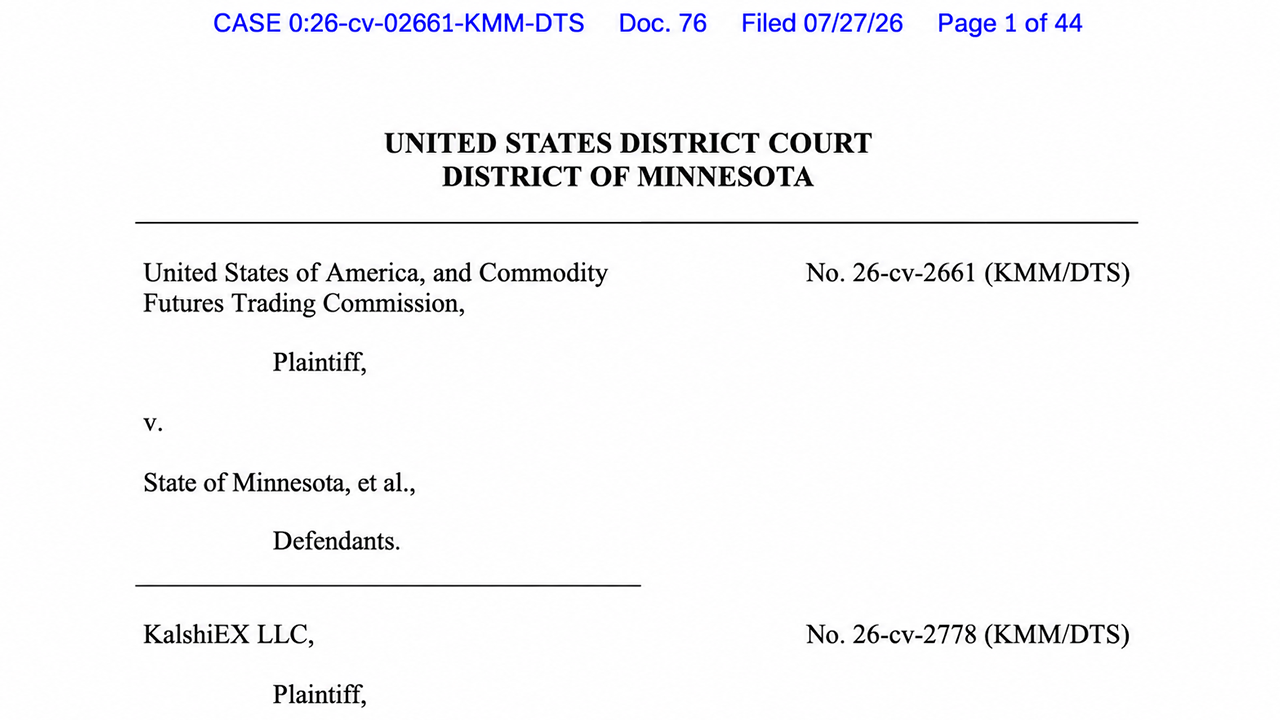
U.S. District Judge Katherine Menendez’s 44-page order prevents Minnesota officials from enforcing Minnesota Statutes Section 609.7615 against entities registered with the CFTC as designated contract markets until the court reaches a final decision on the merits.
The injunction arrived days before the statute was scheduled to take effect Aug. 1. Minnesota SF 3432, signed by Gov. Tim Walz on May 26 as Chapter 118, makes it a felony to create or operate covered prediction markets, facilitate their operation, supply certain data or payment services, or advertise products promoting prohibited transactions.
Walz signed an earlier prediction-market ban through SF 4760 on May 18, prompting the CFTC to sue the following day and Kalshi to file on May 28. SF 3432 subsequently repealed those provisions and replaced them with the language now codified at Section 609.7615, which is the statute Menendez enjoined. Minnesota is the first state to criminalize prediction markets directly, rather than pursuing them through existing gambling statutes.
Kalshi had previously sued to block the ban, while the CFTC and Polymarket U.S. filed related challenges. All three argued that the Commodity Exchange Act gives the CFTC exclusive jurisdiction over qualifying swaps traded on federally designated contract markets, leaving Minnesota unable to criminalize those transactions under state law. Menendez found the plaintiffs likely to succeed on that express-preemption argument for at least a substantial portion of the contracts at issue, applying a broad interpretation of the swap definition at the preliminary-injunction stage.

Menendez identified contracts tied to a U.S. Senate election, the winner of the World Cup, and the reopening of traffic through the Strait of Hormuz as examples likely to meet the federal definition of a swap – hinging on whether an event contract is associated with a potential financial, economic, or commercial consequence. Because Kalshi and Polymarket US offer those transactions on CFTC-registered markets, the court found that federal jurisdiction over them is likely exclusive.
Menendez rejected the idea that every contract listed on a federally registered exchange necessarily receives the same protection. A Kalshi market on which couple would win season eight of Love Island USA, along with contracts covering words spoken by announcers during World Cup broadcasts, appeared to lack the financial, economic or commercial consequences needed to qualify as swaps. The judge similarly questioned whether a contract on one team taking a 20-point lead during a game would meet the federal definition.
The CFTC confirmed at a July 2 hearing that its challenge is facial, a posture requiring plaintiffs to show there is no set of circumstances under which the law would be valid. Menendez wrote in a footnote that the statute “may not be preempted in all its applications,” but found the state law “likely preempted in many respects,” concluding that temporarily enjoining enforcement preserved the status quo while the issue developed further.
The judge also said that both sides had treated the dispute as all-or-nothing propositions, despite the platforms offering many contracts that likely fall within CFTC jurisdiction and many that may not. A contract-by-contract injunction would have been difficult to administer before Aug. 1, while refusing relief altogether would have exposed the platforms to potential felony prosecution. The court therefore blocked enforcement of the statute as a whole against CFTC-registered designated contract markets while the cases proceed, cautioning that any permanent injunction may be “much narrower” because the plaintiffs had not shown that every event contract they list qualifies as a swap. The order also left the plaintiffs’ implied-preemption and First Amendment arguments undecided.
The CFTC initially sought a decision by July 17, and later told the court it would treat its motion as constructively denied and seek interim relief from the Eighth Circuit if no ruling or stay arrived by July 28. Kalshi and Polymarket US said they would do the same. Menendez ruled the day before that deadline expired.
Kalshi told the court it had more than 90,000 verified Minnesota users as of May 26, with millions of dollars in unsettled positions. Menendez found that, without an injunction, Kalshi and Polymarket US would have faced a choice between exiting Minnesota and canceling trades or continuing to operate under the threat of felony charges. Because sovereign immunity would bar the platforms from recovering damages from the state, the court treated those losses as irreparable rather than merely financial.
Minnesota Attorney General Keith Ellison said the state respectfully disagreed with the ruling and would continue defending the law, describing the platforms as predatory gambling operations.
Federal record remains mixed on this matter: the Third Circuit shielded Kalshi in New Jersey in April, while a Washington state court granted that state an injunction against Kalshi in July after rejecting the same preemption defense. Massachusetts, Michigan and Nevada have also secured orders restricting Kalshi’s activities, and more than 40 states have pushed back on the CFTC’s position that sports event contracts fall under exclusive federal oversight.